Product Roadmap & Launch Sprint
Decide what ships next. Make room to build it.
I turn competing requests and customer evidence into a focused release, clear requirements, and a roadmap your team can act on.
Discuss your next release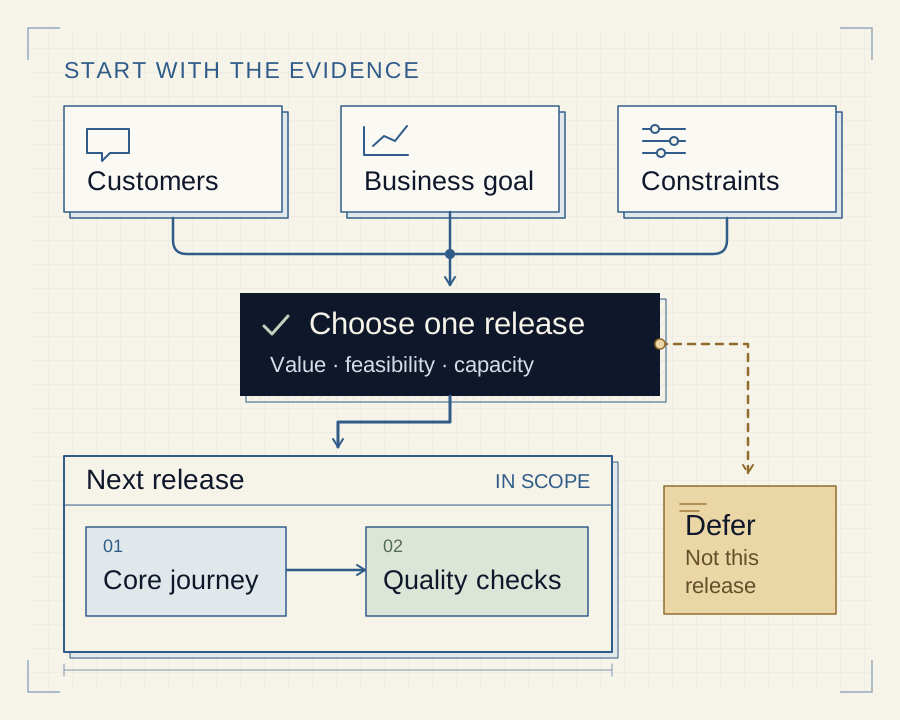
Choose the release from the evidence. Show the order of work—and what stays outside it.
View full diagram- Format
- Two-week option; scope and access agreed first
- Focus
- One product or initiative
- You leave with
- An agreed release and a sequenced roadmap
A roadmap should help you make choices.
Useful when the request list keeps growing and the next release is still unclear. These are illustrative product decisions.
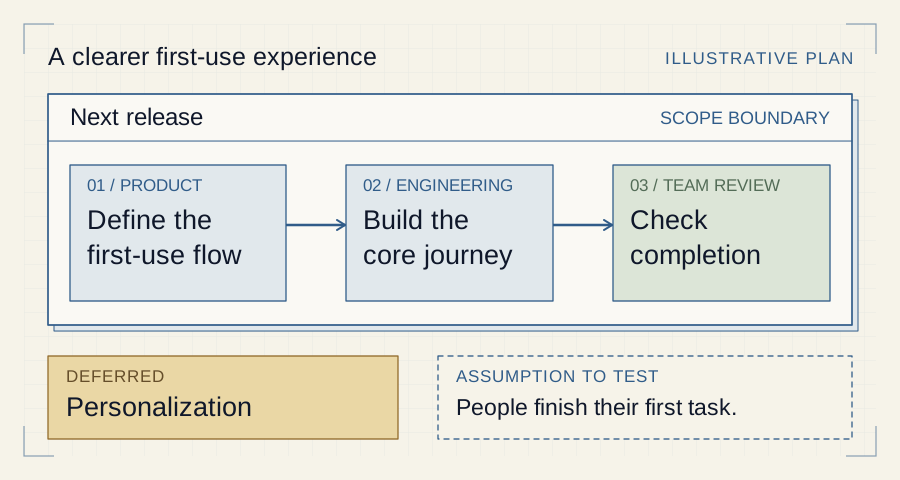
An example of the handover. Product defines the flow, engineering builds the core journey, and the team checks completion. Personalization stays outside this release. This is an illustration, not a client plan or a delivery promise.
View full diagramToo many priorities
The tensionEvery stakeholder has a different idea of what matters most.
The decisionA release goal grounded in customer evidence, with explicit choices about what to defer.
An expanding release
The tensionNew requests keep arriving, and the finish line keeps moving.
The decisionAn agreed scope boundary and a clear list of work to build, defer, or stop.
Work without enough definition
The tensionEngineering has feature names but unanswered questions about the intended experience.
The decisionRequirements, acceptance criteria, and a sequence that makes dependencies visible.
From competing requests to buildable work.
I develop the options and prepare the work. Your product sponsor makes the priority decisions, with engineering involved in feasibility and estimates.
Find the problem worth solving
I review feedback, research, usage evidence, and commitments, then speak with stakeholders and available customers. We separate what we know from what needs testing.
You getA product opportunity brief with evidence and open assumptions
Draw the release boundary
We compare options and decide what belongs in the next release. Where useful, I create a lightweight prototype or workflow illustration to examine an open question.
You getPrioritized scope and an explicit defer or stop list
Make the work ready to build
I develop requirements, acceptance criteria, and success measures, then sequence the work with your engineering owner. We record dependencies, owners, and unresolved decisions.
You getRequirements, a sequenced roadmap, and a decision readout
The sprint covers one agreed product or initiative. Production development is scoped separately; a roadmap does not guarantee a launch date or validated demand.
A few practical questions
Can we do this in two weeks?
A two-week format can work once scope, access to evidence, and decision-maker availability are confirmed. We agree timing before starting, based on the questions the sprint needs to resolve.
What if we already have a roadmap—or little research?
I use the roadmap and evidence you have, and arrange customer conversations where access allows. I label assumptions clearly and identify the research still needed before larger commitments.
Who needs to take part?
A product sponsor who can decide priorities, an engineering owner, and relevant design, customer, or commercial colleagues. We agree working sessions and access to product information in advance.
What happens after the sprint?
Your team receives the decisions, requirements, and sequence of work. Development and ongoing product ownership are agreed separately. A prototype, where included, helps examine an idea; it is not production software.
Next step